
Ask a model for a class of children in soft clay, then for the same children floating over Riyadh, and it will cheerfully hand you two different classes. Lovely children. Wrong children.
That problem sat at the centre of the film we worked on with NaF+ for Toyota, marking Saudi National Day and Abdul Latif Jameel’s 80th anniversary. Toyota wanted to celebrate the Kingdom through the eyes of its children. The story starts in a classroom, where a group of students build a model of the desert, and follows their imagination into the worlds they dream up.
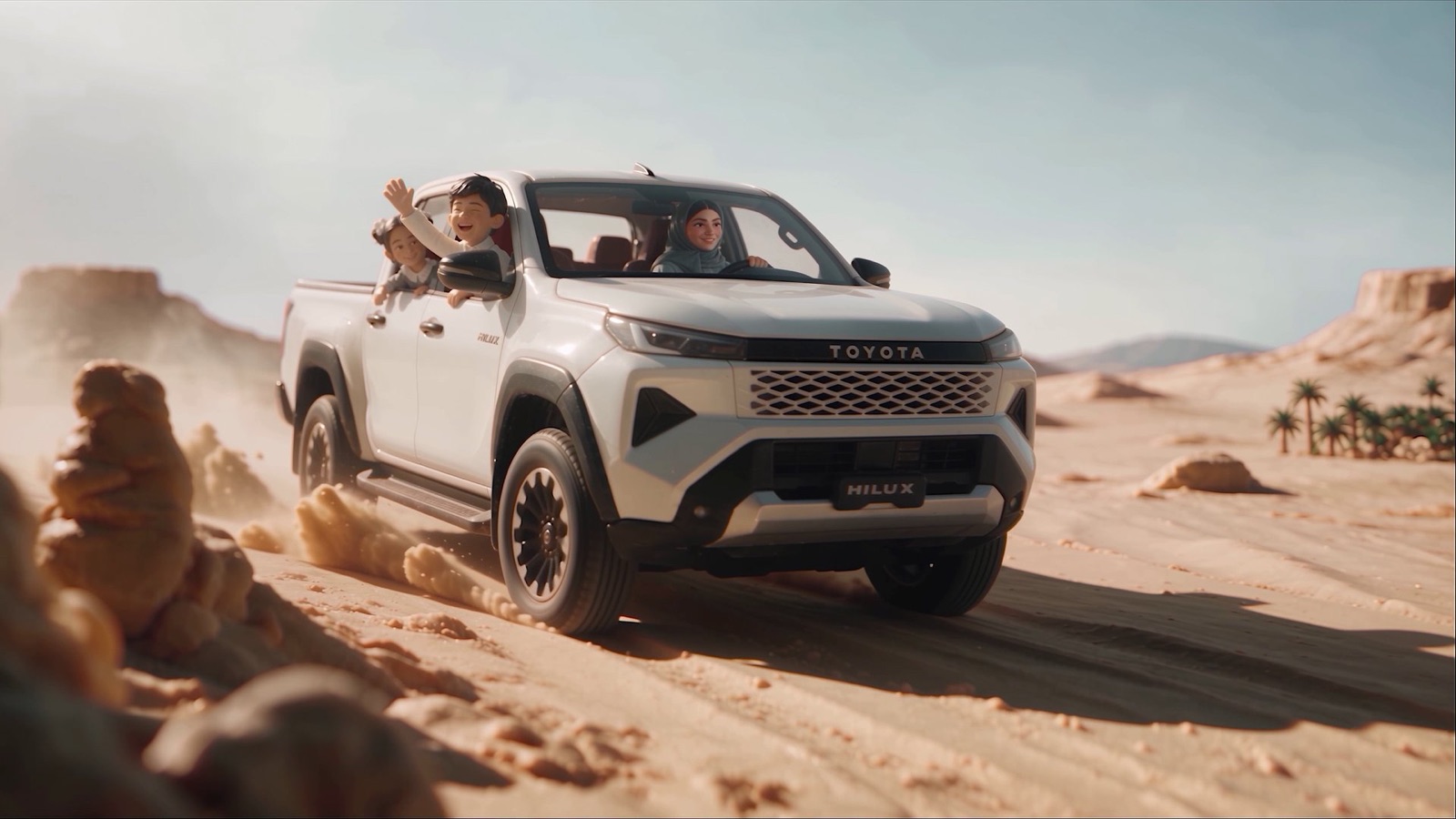
We led the AI production of those imagined worlds and the transitions that carry the children in and out of them. A soft clay seaside. A trip into space. Balloons lifting over Riyadh. A sand wave that drops the class into the desert beside a Toyota Hilux. The Toyota National Day case study shows the frames better than I can describe them.
Changing the style is the easy half of the job.
Each world has its own art style, and the same children stay recognisable from one to the next. The second half of that sentence is where the work lives. Ask for clay and you get clay. Ask for the same girl in clay and in a painted night sky and the model has no idea she is supposed to be one person. Her face in one style shares almost nothing with her face in the other, so she drifts unless someone holds her in place.
The audience notices drift faster than any reviewer. A child at home will spot that the boy came back from space with a different haircut long before the brand manager does. Once that happens, the audience starts playing spot the difference, and the story loses them.
Decide what makes each child recognisable before you choose a look.
If you are planning a film like this, here is the discipline I would insist on. For every child, write down the handful of features that must survive any style: face shape, hair, a piece of clothing, the way they stand. That is the identity. Everything else belongs to the world and can change as much as the art director likes.
Then test every child in every style early, before a single scene is built, and put the results side by side. Think of it as a police line-up for cartoons. If you can’t point to the same child across the row in a couple of seconds, fix the character before you fix anything else. Reviewing one world at a time hides drift. Reviewing across worlds exposes it.
The match cut starts in the live action.
Transitions in the Toyota film were designed to match-cut from the live action, so the jump from classroom to imagination feels effortless. A match cut means the generated world inherits something from the real frame: where a child sits, the direction of a movement, the shape of an object, the framing. The live footage becomes the brief for the AI shot.
The story structure helps here. The children build a model of the desert in the classroom, and the last world drops them into the desert itself. The objects in a real room become the doorways into the imagined ones. My advice for any hybrid film of this kind: whoever shoots the live action and whoever builds the worlds should agree on the cut points before the camera rolls. Inventing a bridge between two shots that were never designed to meet is slow, and it shows.
Guidelines belong in the art direction.
Every frame had to be delivered in line with Toyota, ALJ and Saudi advertising guidelines. That is three rulebooks on one film, before anyone has an opinion about colour. I won’t pretend to summarise those rules here. The practical point is when you bring them in: at the start of look development, alongside the references, so every world is designed inside them. Finding a problem in a finished world means rebuilding a world.
The same goes for the product. A Hilux in a sand wave is still a Hilux, and it has to look exactly like one. Imagination is allowed to bend the world. Nobody gets to bend the vehicle.
The fun of a film like this is the worlds. Whether it works depends on something less glamorous: nobody watching should ever wonder whose children these are. Change the world as much as you like. Keep the class.