
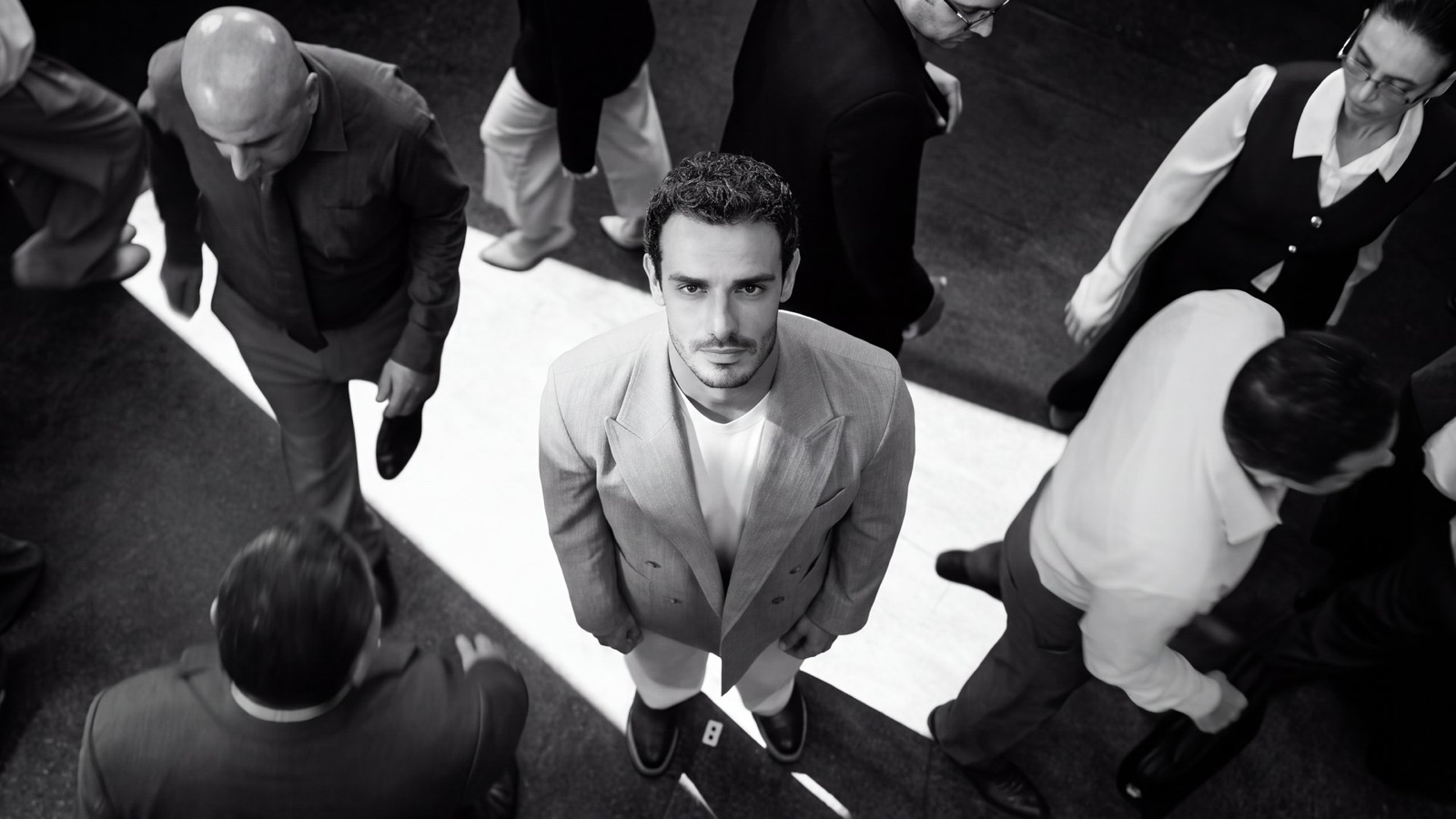
Picture an empty blue studio with one man standing in it. Now picture the finished film: monumental concrete halls, sweeping arches, hard light falling across him. The distance between those two images is the whole job.
That was Que Gardens. Working with Lobster Films, the brief was a campaign film with the scale of a major architectural shoot, on a timeline that left no room for one. Lobster Films shot the talent on a blue screen. We built everything around him: a black and white world of raw concrete and hard light, from vast halls to an overhead crowd shot that isolates him in a single pool of light. Every environment was generated, art directed and composited in-house. The before and after on the Que Gardens case study makes the point faster than I can: an empty studio on one side, a finished frame on the other.
The hard part is making him belong in the frame.
Generating an impressive concrete hall is the easy bit now. Making a real man look as if he is standing in it is where hybrid work succeeds or falls apart. On Que Gardens we matched lens, perspective and shadow shot by shot, so each plate sits naturally inside its world.
Each of those can give the game away on its own. If the man was filmed close on a wide lens and the hall behind him has the flattened depth of a long lens, the eye feels it even when the viewer can’t name it. If the camera height in the plate and the horizon in the environment disagree, he floats. If the hard light in the world comes from the left and his shadow also falls to the left, he was pasted in, and everyone can tell. Black and white makes this stricter, because there is no colour to distract from a tonal mismatch.
Then the film was carried through edit, grade and finishing. The grade is the glue. It puts the man and the world under the same light, which is how a composite becomes a shot.
ORA Madinat Al Ward went fully AI, for good reasons.
For contrast, take the film for ORA Developers Iraq, relaunching the Al Waha Plus villas at Madinat Al Ward, its new city in Baghdad. The brief was to sell the homes the way a buyer experiences them: the architecture, the materials, the light moving through each room. We produced that commercial fully with AI, working from the client’s scene brief and the development’s own renders, so every facade, finish and floor plan stayed true to the real villas.
The people in that film were built from locked character sheets, with casting, wardrobe and every human moment directed with the local audience in mind, so the film feels premium, modest and at home in Iraq. A single cinematic grade held it together. Nobody in it had to be a specific real person. The truth that needed protecting was the architecture, and the renders already held it. There is more on the ORA Madinat Al Ward case study.
How I decide between hybrid and fully AI.
The question I start with is which part of the film has to be real. A few tests:
- A specific person has to appear. A named ambassador, a founder, an actor whose face is the campaign. Shoot them.
- The performance carries the film. Close-ups, emotion, dialogue. A real actor gives you that on the day, and you can direct it in the room.
- The world is the expensive part. Architecture that doesn’t exist yet, or places you can’t get a crew into. Generate it.
- There is a source of truth for the place. Renders, plans, materials. A fully AI film can stay accurate to them.
- There is no room for a shoot day. A hybrid still needs a studio and talent on a given date. Fully AI takes that day out of the schedule.
If you go hybrid, plan the shoot for the composite. Decide camera height, lens and light direction for every plate before the shoot, with the people who will build the environments in the room. A blue screen day run like a normal shoot, with the world worked out afterwards, hands the compositing team a pile of plates that fit nothing.
Que Gardens needed a real man in an impossible place. ORA needed real homes with believable families in them. Two different answers to the same question. Shoot what has to be real, and build the rest.