
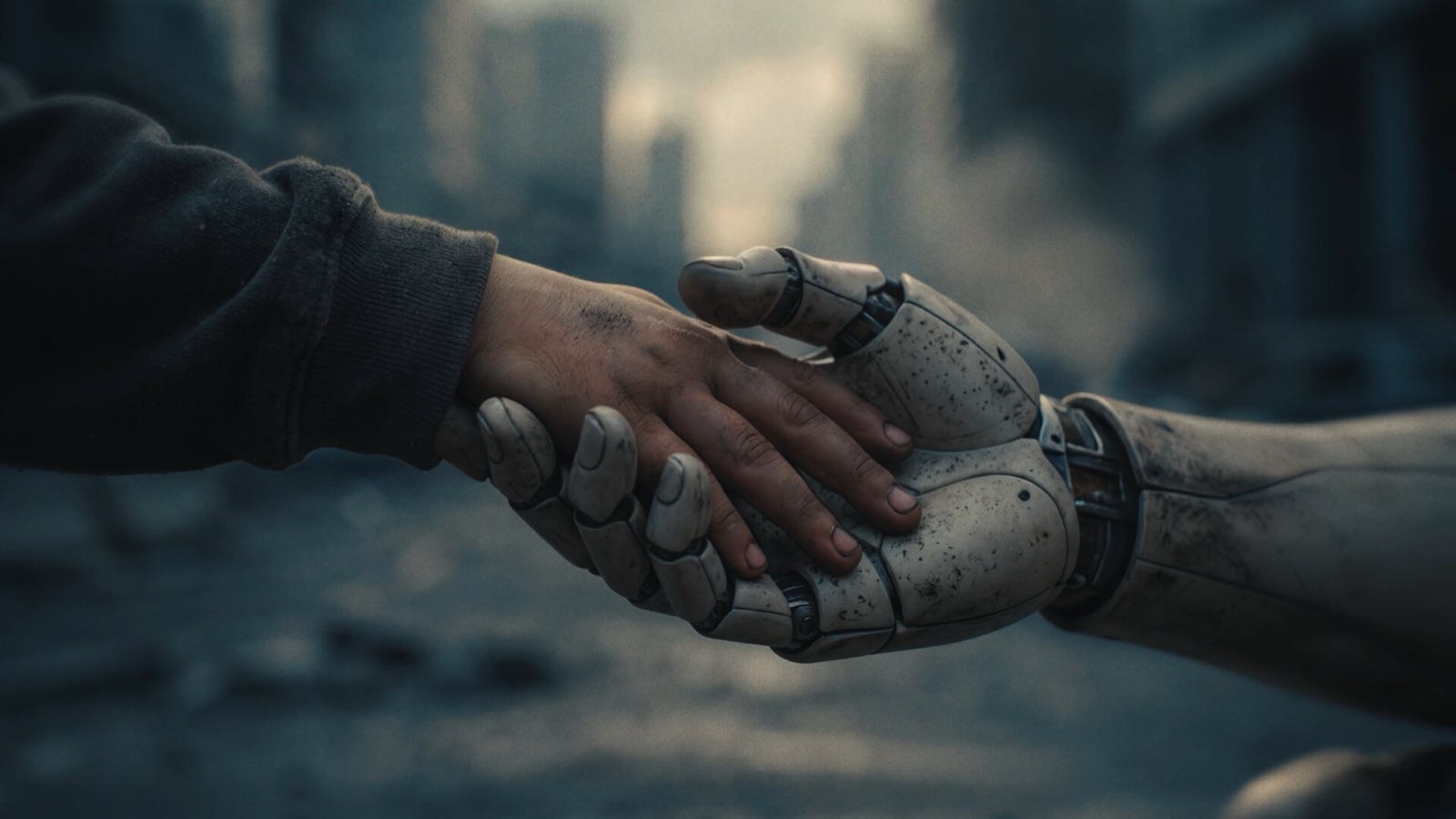
Before Us is an original science fiction trailer we made for United for Humanity. It imagines a world at breaking point, where war and fear push civilisation to the edge and the future comes down to one choice: destruction or connection. We led the full AI production, from world building and shot design to character performance, edit and grade. There was not a single day on set.
Projects like this invite the assumption that the result fell out of a prompt box. So here is what AI made easier, and what still took people and time.
Scale got easier.
The trailer moves from aerial combat and collapsing cities to quiet human moments. A few years ago, a teaser with that kind of scale would have needed a studio budget and a visual effects house. Every environment, character and effects sequence here was created in-house. That freedom changes how you write: the story decides the shot, and the budget loses its veto.
That is the real shift. Building a burning skyline or a fleet in the air is no longer the expensive part. The ambition of an idea now depends more on the people directing it than on the money behind it. Good news for small teams with big ideas. Awkward news for anyone whose only advantage was budget.
Consistency still took discipline.
A trailer needs the same faces, costumes and machines from the first shot to the last. Models drift in small ways. A jawline softens, a uniform loses a detail, a ship grows an extra fin. Each shot can look great on its own and still break the film.
Keeping a world consistent needs locked references for every character and object, plus someone checking continuity across the whole timeline. It also needs the willingness to throw away a beautiful shot that does not match, which is the hardest part. Nobody likes deleting their favourite frame. Do it anyway.
Performance is where the people are.
The scale shots get the attention. The quiet moments carry the story, and they are harder to get right. A face has to hold a feeling without sliding into a mannequin stare or an overacted grimace. Direction matters more here than anywhere: what the character is thinking, and how long the pause lasts before they move.
Commercial work has the same problem. When we led the AI production of the Silicon Park campaign film for Imperio, the film had character-driven moments inside the architecture, and those people needed the same care as the buildings around them. Audiences forgive a stylised world much faster than a dead-eyed person.
Edit and grade still decide the film.
AI gives you shots. A trailer is rhythm, and rhythm comes from the edit. The cut decides when the scale lands and when the noise drops away for the final image. Before Us closes on a human hand meeting a machine’s. That shot works because everything before it builds towards it, and an editor decided how.
The grade has the other half of the job. Generated shots come from different runs with different ideas about light and colour. Bringing them into one world takes a colourist with a good eye, working shot by shot. That part of the process feels very close to finishing a live action film, and it deserves the same respect in the schedule.
So what was still hard? Everything that needed judgement. AI removed the set and the weather. It left the director, the editor, the colourist and the person whose job is to say “that shot does not match, go again.” I would not want it any other way. Somebody has to be the annoying one, and it may as well be someone with taste.